
Every year, a lot of people sit down in late December and make new year resolutions. They want to get stronger, earn more, save more or spend more time with the people who matter. For a few weeks the energy is high and the plan feels exciting. Then, somewhere around the first or second month, many of those resolutions quietly stop. The gym bag stays in the car, the budget app goes unopened, and by spring the goals are forgotten.
It doesn’t have to go that way. If you have ever wondered why most people fail to achieve their goals, part of the answer is that they plan ahead without first looking back. This year, you can start from a clear understanding of where you stand today, choose goals that really matter to you, and build simple actions and reminders that keep you going all year. This guide walks you through the whole process, step by step.
Look Back at Your Last 3 Years First
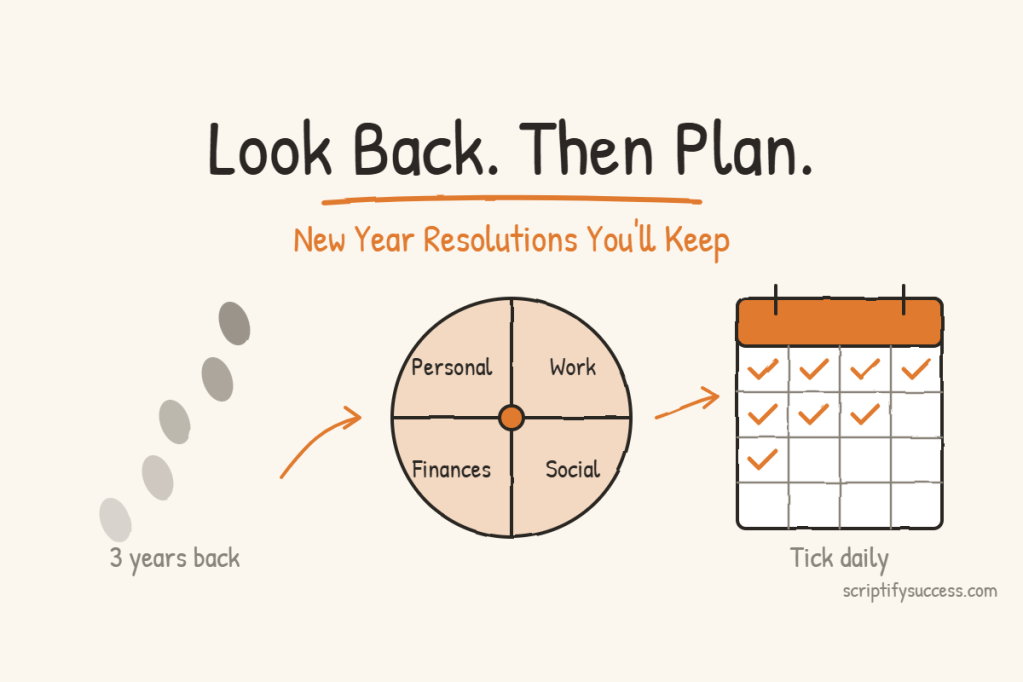
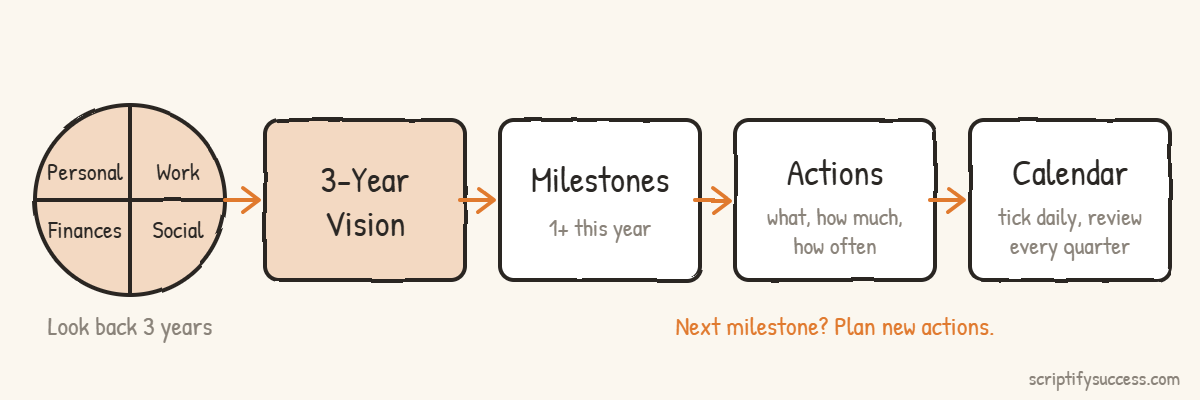
Before you set new year goals, take some quiet time to look back. Don’t stop at the past twelve months, though. Go further and look back at the last three years, because one year is often too short to show a pattern, while three years shows you which way your life is really moving. Look at four areas of your life one by one: personal, professional, finance and social. Be honest with yourself, because nobody else needs to see these answers.
Your Personal Life
Start with your health and your energy. Do you wake up feeling energetic and joyful most days, or do you feel stressed and tired most of the time? Think about how an ordinary day usually flows for you and how you feel at the end of it. Ask yourself whether you are able to spend some time on your own growth in any field, whether that is learning a skill, reading or building something of your own. Also ask whether you have a hobby that gives you energy, or whether that part of your life has slowly disappeared over the last three years.
Your Professional Life
Next, look at your work. Are you doing well in terms of earnings? If you run a business, is it growing, and if you work in a company, are you moving up the corporate ladder or staying in the same place? Then ask the harder question: what is really bothering you about your work, and why? Sometimes the thing that bothers us is just peer pressure, because a friend got promoted or a classmate started a company, while other times it is something that truly matters to you. Only honest self-analysis can tell you which it is.
Your Finances
Money deserves its own careful look, and it helps to think in real figures instead of general feelings. Start with how you manage your money and whether you are saving and investing regularly. Then look at your spending. Is it under control, or does it follow your mood and turn into emotional decisions made in the moment? Are you spending every dollar you earn, or are you putting enough aside for your future? As a simple example, someone who earned $70,000 in a year but saved only $2,000 would want to ask where the rest went and how much of it was really planned.
Once you have an honest picture, ask a few more direct questions. Are your investments doing well, or do you need professional advice to understand them? Check every part of your money life that bothers you, and then ask whether you are satisfied with where you are today. Finally, ask what bothers you more: earning too little, or saving too little because you spend too much. Your answer will point you toward the right money resolution.
Your Social Life
The last area is your social life. Are you connected with people you admire and can learn from, or is your circle mostly made up of people who drain your energy and feel jealous when you grow? Think about whether you have made any new friends in the area where you want to excel in life. Ask yourself whether your relationships are healthy, and whether they make you happy and proud. Then notice what feels missing here, and write it down alongside your answers for the other three areas.
Find What Is Missing and How Much It Matters to You
When you have gone through all four areas, write down what is missing in each one. These are the things you wanted to have or achieve over the last three years but didn’t. For each item, ask yourself a simple question: do you still feel it is important to you today, and why? Some goals that felt huge three years ago may not matter anymore because you have new targets. For example, you may once have wanted a bigger car, but today you care more about having time and energy for your family in the evenings. It is perfectly fine to let goals like that go.
For the items that still matter, look at the reasons behind them and how much they matter to you emotionally. This step is important, because when a goal carries real emotional weight, you have a much higher chance of following your plan when things get hard. A goal you only think you should want tends to fade quickly, while a goal you feel strongly about keeps you coming back to your plan, even on hard days. Rank the areas by how much you want to improve them and how deeply you care about each one.
By the end of this exercise, you will have a clear picture of where you are today compared with where you were three years ago. You will see how much you progressed, where you stayed still, and what is still missing that you are looking for. That picture becomes the foundation for everything that follows.
Plan Your New Year Resolutions With a 3-Year Vision
Now it is time to plan for next year, and the list you just made is where that plan begins. The things that are still missing and still matter to you, especially the ones with the strongest emotional pull, become the starting points of your vision for the next three years. Your new year resolutions should then line up with that vision, which goes beyond a single year. A yearly plan is a practical time frame for goals, and when it becomes one stage of a bigger three-year journey, it carries even more meaning. Make sure your resolutions support each other instead of pulling you in different directions. Also make sure each of the four areas of your life has at least one resolution that helps improve it.
10 Steps to Set Goals the Right Way for the New Year
If you have ever wondered how to set goals that last beyond January, the ten steps below take you from choosing the goal all the way to reviewing your progress through the year. Follow them in order, because each step builds on the one before it.
Step 1: Choose Your Area and Dream Without Limits
Pick the area you most want to improve, usually the one that ranked highest in your look-back, and decide what you want to achieve there. While you are planning, don’t let your present reality and situation define the goal. If you start from your current limits, you are likely to set a goal that is too small to excite you. Instead, read some book summaries, listen to podcasts, and learn about people who did something big in that area. Then plan the goal that truly excites you.
Step 2: Define Your Goal Clearly
A vague goal is easy to drop, so define yours clearly with all its details. A good test is to imagine explaining it to a teenager. If they could picture what it looks like and how it feels, your goal is clear enough. Be sure to describe how you will feel once you reach it, not just what you will have.
For example, “I want to be better with money” is vague. A clear version might be: “In three years, I have a full year of living expenses saved in a separate account. I pay every bill without checking my balance first, and I feel calm and in control whenever I think about money.” Try writing your goal several times with small variations, so you can see which version is clearest and closest to your vision.
Step 3: Align Your Goal With Your Family
Your goal should also fit with the vision of your partner and family. When two people hold different visions about shared parts of life, such as buying a house or a car, both goals become harder to reach. You need to be working toward the same goal, not toward different ones. Talk it through, refine your goal if needed, and then write the final version down clearly.
Step 4: Set Milestones and Celebrate Them
A big goal needs milestones that tell you whether you are on track. Think of each milestone as a smaller version of your big goal, and plan them so that you can reach one or more within the coming year. For example, if your three-year goal is a full year of living expenses saved, your milestones might be one month saved by spring and three months saved by the end of the year. When you reach a milestone, celebrate the win, because those celebrations give you a reason to keep going.
Step 5: Plan the Actions for Your First Milestone
Now plan the exact actions you need to reach your first milestone. Each action should be very clearly defined: what you will do, how much time or quantity it involves, and how often you will do it. For example, instead of “exercise more,” you might write “strength training for 30 minutes, three times a week” if your goal is more strength and stamina. Instead of “save money,” you might write “move $300 into savings on the first of every month,” using whatever amount fits your own situation. Write all of these actions clearly on paper.
Step 6: Add at Least One Action in the Other Three Areas
The first five steps were for your main area, the one key area you want to focus on and improve this year. Now add at least one action in each of the other three areas of life. Bigger growth and greater success come when every part of your life supports them. Even one small action in each area keeps your whole life moving forward together.
Step 7: Plan Some Actions With Your Family
Try to plan some of your actions with your partner, spouse or kids, treating them as your partners in the plan. For example, a walk together after dinner or a regular money check-in with your partner turns a resolution into something you share. This gives you someone to work with, and it also gives you natural checkpoints along the way. The people close to you can remind you and encourage you when you need it.
Step 8: Keep Your Big Goals to Yourself
Don’t share your big goals with anyone outside your family. Here is the reason: when you share a goal and people praise you for it, the good feeling from that praise (a little burst of dopamine) can make your brain feel as if the purpose is already fulfilled. After that, it stops pushing you as hard to actually reach the goal.
There is a second reason too. Some people may discourage you by giving wrong examples, or by judging your vision from their own limited experience of life, often from a point where they haven’t achieved much themselves. You need to keep that kind of negative feedback away from your vision and big goals. So keep your big goals private. You can share the actions you have started taking, without revealing the real goal behind them, and only when someone asks you directly about your new year resolutions.
Step 9: Put Your Actions on a Printed Calendar
Get a calendar printed with your planned actions marked on it, and put it somewhere you will see it every day but your guests won’t. If you prefer, use a personal notebook with a printed calendar inside, or even a simple printout. The format doesn’t matter much, as long as you see it daily and, at the end of each day, mark a tick next to every action you completed. Those ticks become a visible record of your progress, which is exactly why tracking progress is essential for success.
Step 10: Review Every Quarter
Every quarter, sit down and review your plan. Check whether you followed all your actions or missed some, and see how far you have come toward the first milestone of each goal in each area of life. Then keep following your planned actions for the next three months without changing them. The actions you take in the first few months need time to create results, so it is too early to judge them at your first review. After six months you have had enough time to gauge what each action is producing, and that is the right point to refine any action that needs changing.
Remember that these actions were planned for your first milestone only. Once you reach it, celebrate the win and then plan the actions for your next milestone, because it may need different actions from the first. Follow those new actions through in the same way, with your calendar and your quarterly reviews.
Try This
Before the year ends, set aside one quiet evening and do the following:
- Answer the reflection questions for all four areas: personal, professional, finance and social, looking back over the last three years.
- Write down what is missing in each area, and whether it still matters to you and why.
- Circle the one area that matters most to you emotionally, and write your big goal for it in a way a teenager could picture.
- Choose one clear action for each of the other three areas.
- Print a simple calendar and mark your first month of actions on it.
Frequently Asked Questions
Why look back three years instead of one?
One year is often too short to show a pattern. Three years shows you which way your life is really moving in each of the four areas, including what is still missing.
How many new year resolutions should I make?
Choose one main area for your big goal, then add at least one action in each of the other three areas. That way, each of the four areas of your life has at least one resolution, and your resolutions support each other instead of competing.
Should I tell people about my new year goals?
Keep your big goals to yourself, apart from your family. Praise for a goal can make your brain feel as if the purpose is already fulfilled, and some people may discourage you based on their own limited experience. Share only the actions you are taking, and only when someone asks about your resolutions.
How often should I review my goals?
Review every quarter. Check which actions you followed and how close you are to your first milestone, then keep going for another three months. After the six-month review, refine any actions that need changing.
Key Takeaway
New year resolutions fail when they start from a wish instead of an honest look at your life. When you look back at your last three years, choose goals that matter to you emotionally, and support them with clear actions, family involvement and a daily calendar, your resolutions can last the whole year. If you are new here, the Start Here page is a good next stop for goal setting for the new year and beyond.


Leave a Reply