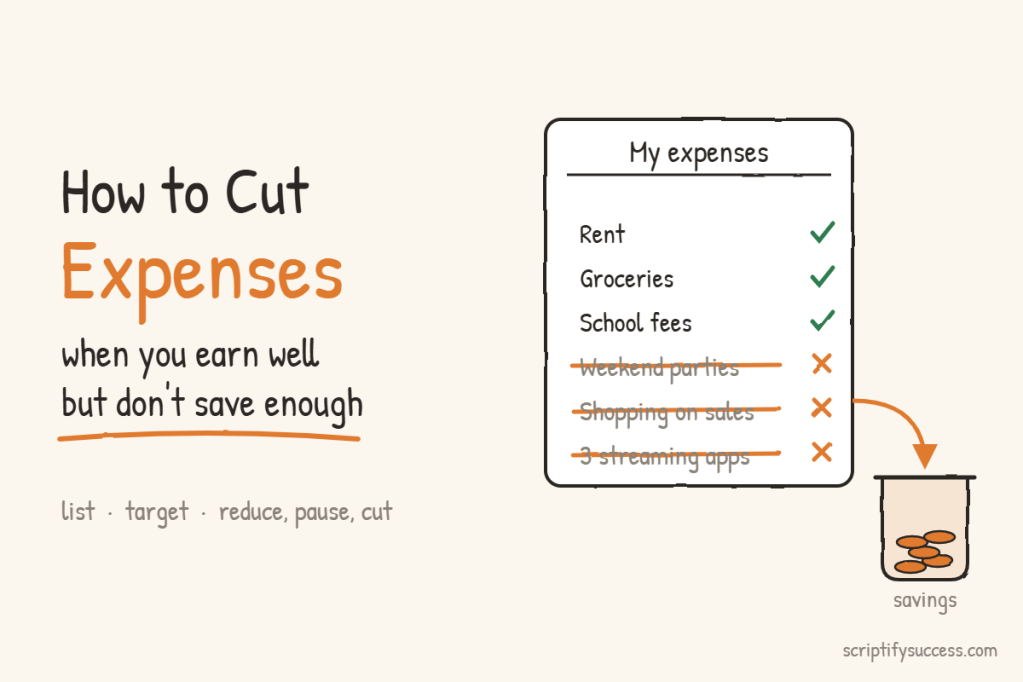
As your earnings go up, your expenses usually go up with them. That is why so many people never manage to save as much as they once planned, even after a few good raises. If you are earning well but not saving enough, the reason is usually your spending, and if you have been searching for how to stop spending money, this is most likely the situation you are in. Spending is the most interesting area of personal finance because it can affect anyone, from low earners to high earners, so let’s first understand your spending and then fix it.
Know Your Present Situation
Start by looking honestly at where you are today. Are you single, living with a partner, or a family with kids? Are you the only earner in your home, or do both of you earn? Each of these situations comes with its own kind of spending, and a family with school-age children cannot spend the way a single person does. Accept where you are today and build the rest of your plan around it, rather than around a life you are not living right now.
Ask Yourself Why You Want to Save More
Next, ask yourself a question that matters more than any number: why do you want to save more? Be clear about where this wish comes from. Do you feel you are not saving enough for your future and for the things you want to achieve? Or is it simply that you spend every dollar you earn, and it bothers you that nothing is left at the end of the month?
Both reasons are real, but they are not the same, so also ask how important this is to you emotionally. A reason that truly matters to you will carry you through the hard choices ahead, while a weak reason will fade the first time cutting an expense feels uncomfortable. Write your reason down in your own words, because the decisions in the rest of this article will lean on it.
Make Three Lists From Your Last Six Months of Spending
Now use your actual spending to build three lists. Pick up the details of what you spent over the last six months from your credit card statements, bank statements, any bills you have, and the text messages or emails you receive from your bank or from merchants. If there isn’t much data to work with, keep a record of every expense for the next three months first, and then build the lists category by category. I have explained how to gather this data in more detail in How to Manage Personal Finances.
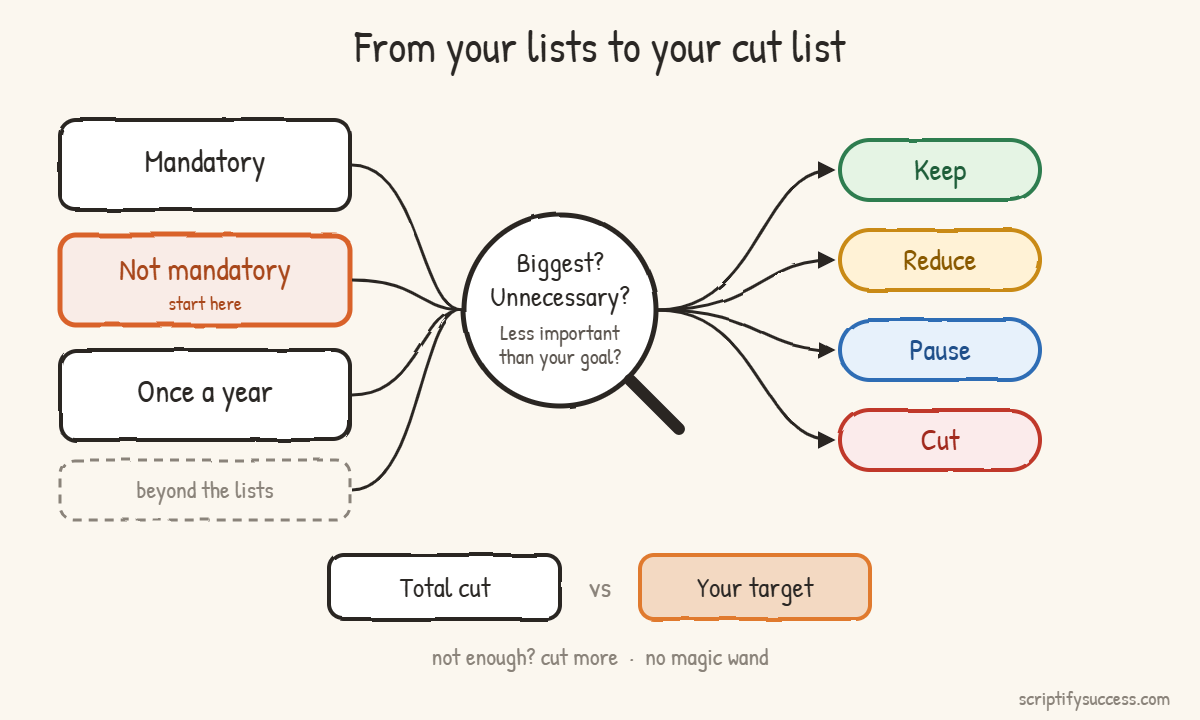
Sort every expense into one of three lists: mandatory expenses, expenses that are not mandatory but still happen, and one-time expenses that come once a year. If you have read What Is Personal Finance?, you will notice this split sits close to the line between needs and wants. For each list, be clear about both the amount and where it was spent. Then look at what falls beyond all three lists, because those are often the expenses you had not even thought about.
Mandatory Expenses
These are the expenses you have to pay no matter what, and for most households they include the following:
- Rent, or the monthly payment on your home loan (mortgage)
- Groceries and other food expenses
- Any other loan installments
- Fees, such as school fees for your kids
- Clothes you need per season or per year
- Car insurance
- Home insurance
- Student loan payments, if you have any
Expenses That Are Not Mandatory but Still Happen
This second list is made of things you could live without, yet they keep showing up. Think of shopping on sales, parties on the weekend, travel and sightseeing to relax, and subscriptions such as magazines or several streaming apps at once. None of these is wrong in itself, but together they often make up a large part of what you spend. This list is usually where most of your money goes on things you don’t really need.
One-Time Expenses That Come Once a Year
The third list covers expenses that do not appear every month but do arrive every year. Car service or repair and home repair are the common ones, and you may have a few more of your own. Because they come only once in a while, they are easy to forget when you look at a normal month. A simple way to handle them is to set aside a small amount every month in a separate pot, so that when the bill arrives, the money is already there to pay it.
Here is a simple example of how your three lists might look once you add the amounts. The amounts are only examples, so use your own figures and currency.
| Mandatory | Not mandatory | Once a year | |||
|---|---|---|---|---|---|
| Expense | Per month | Expense | Per month | Expense | Per year |
| Rent | 1,000 | Weekend parties | 300 | Car service | 600 |
| Groceries and food | 450 | Shopping on sales | 200 | Home repair | 400 |
| School fees | 200 | Travel to relax | 150 | ||
| Car insurance | 90 | Three streaming apps | 45 | ||
| Home insurance | 40 | Magazine | 15 | ||
| Total | 1,780 | Total | 710 | Total | 1,000 |
Keep Your Lists Up to Date
These lists are not a one-time exercise. Visit them at least once every year, and especially after big changes in life, such as getting married or having a child, because your mandatory expenses and priorities change with them. A quick yearly review keeps your plan matched to the life you are living now, not the one you were living when you first made the lists.
Decide How Much You Must Cut
How much you cut should not be a random number. It should come from a target you want to reach with saving or investing, such as how much you want to put aside every month for the future you thought about when you asked yourself why. Once you know that number and the reason behind it, the gap between what you save today and what you want to save is the amount you must cut. Reaching this target may need some changes to your lifestyle, and a clear reason is what makes those changes worth it. Write both the number and the reason down where you will see them, so they keep driving your decisions once the cutting starts to feel uncomfortable.
How to Reduce Expenses: Find Where the Problem Is
With your lists and your target in front of you, you can see clearly where the problem is and how big it is. Look for your biggest expenses and your unnecessary ones. If you have simply been spending without much thought, cutting will be easy, and the not-mandatory list is the place to start, because it shows you plainly where the money is going.
If that is not your case, and most of your spending already feels reasonable, you need to look deeper. Go back to the future goal you want to reach with your savings and how much it matters to you emotionally. Anything you spend on today that is less important to you than that goal belongs on your cut list, starting with the not-mandatory expenses. This way, every cut is a choice you make for something you care about more.
Reduce Some Expenses Significantly
Some expenses do not need to go away, but they can come down a lot. Extra spending on food and groceries beyond what your household really needs is one example, and branded clothes for day-to-day use is another. Partying every weekend is a third, and partying every second weekend instead is already a big reduction. You still eat, dress and meet friends, just without spending more than these things are worth to you.
Pause Some Expenses Completely for a While
Other expenses can be ignored completely for some time. Buying things because they are on sale, when you don’t really need them right now, is the clearest example, because a sale only saves you money if you were going to buy the item anyway. Upgrades at home with new add-on items are another, since most of them can wait a few months without making your life any harder. Pausing is not giving these things up forever; it is simply deciding “not now” until your target is met.
Cut Subscriptions You Don’t Use Every Day
Finally, plan to cut a few expenses altogether, especially subscriptions that you do not use every day. Magazines and streaming app subscriptions are the usual suspects here. If you are paying for something you open only now and then, it is a good candidate to go. Look through each of them and let go of the ones that are not part of your daily life.
Check Your Savings Against Your Target
Now calculate how much you will be able to reduce by bringing some expenses down, pausing others, and cutting the rest. Compare that number with the target you set earlier and see whether it meets the target or whether you still need to cut more. If it does, great, because you now have a plan that works. If it falls short, you will have to cut some more expenses, even ones you would rather keep, because that is the only way to meet the target. There is no magic wand for it.
How to Stop Spending Money Without Fighting Yourself
It also helps to know why you spend on certain things and what emotional need you are trying to fulfill through them. Once you understand that need, cutting an expense becomes much easier, because you can let it go without hurting your emotional self. This side of spending deserves its own space, so I will cover it in detail in a separate article soon.
Try This
- Write down your present situation, why you want to save more, and how much that matters to you.
- Pull your last six months of spending, or record every expense for the next three months, and build your three lists with amounts.
- Set your saving or investing target, and work out the gap you must cut.
- Mark your biggest and unnecessary expenses, and decide which to reduce, pause or cut.
- Add up the savings and compare them with your target. If you fall short, cut more until you reach it.
- Put a reminder in your calendar to revisit your lists every year and after any big change in life.
Key Takeaway
Cutting expenses works best when it is driven by a reason, not just a number. Know why you want to save more and how much it matters to you, and the choices about what to reduce, pause or cut become much clearer.
FAQs About How to Stop Spending Money
How do I stop spending money when I earn well?
Start with your present situation and ask yourself why you want to save more and how much it matters to you. Then build three lists from your last six months of spending, set a target from what you want to save or invest, and reduce, pause or cut expenses until you reach it.
How can I reduce expenses without touching the mandatory ones?
Look first at your biggest and unnecessary expenses in the not-mandatory list. Reduce partying every weekend and branded clothes for day-to-day use, pause buying things on sale that you don’t need right now, and cut subscriptions you don’t use every day.
How do I stop spending money on useless things?
Most of these sit in the list of expenses that are not mandatory but still happen, such as shopping on sales and several streaming subscriptions. If you don’t need something right now, pause it, and if you don’t use a subscription every day, cut it.
What if my cuts are not enough to meet my target?
Then you need to cut some more expenses, even ones you would rather keep. That is the only way to meet the target, because there is no magic wand for it.


Leave a Reply