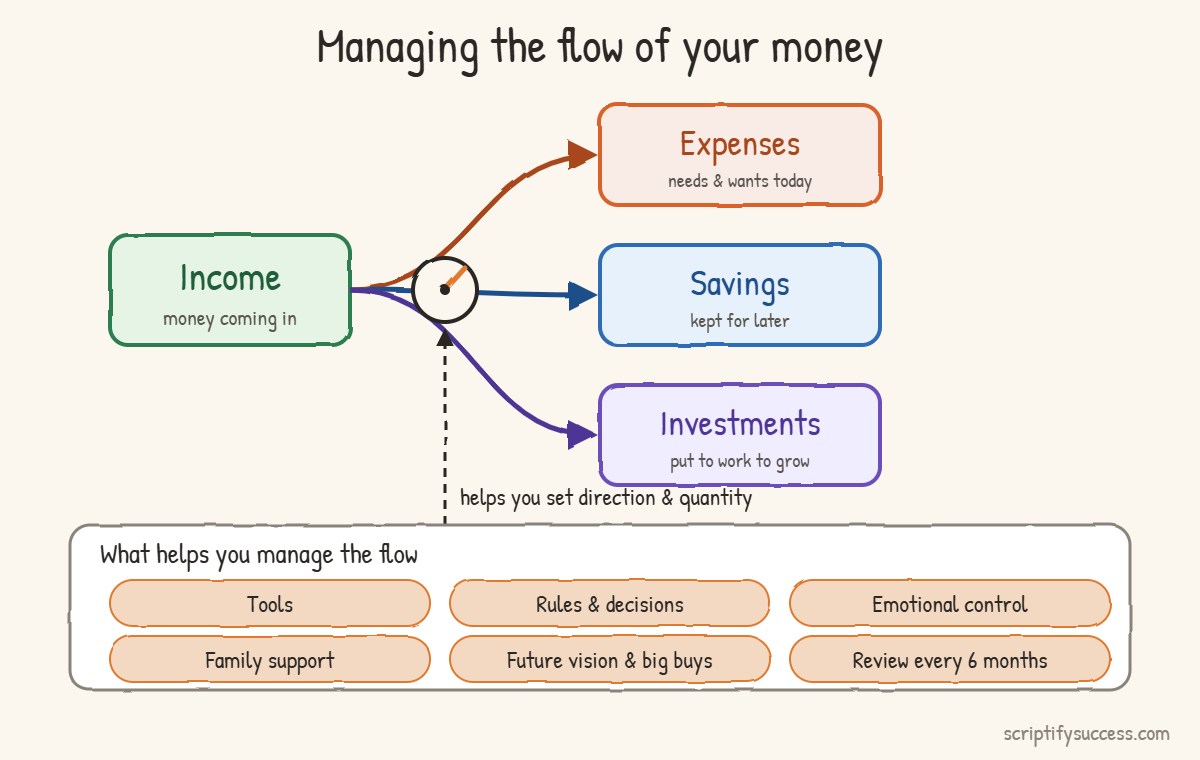
To manage personal finances means to manage the full life cycle of your money as it flows from income into spending, saving and investing. The purpose is to make sure that your life goals that need money, directly or indirectly, are met the way you expect. Some goals need money directly, like buying a home, while others need it indirectly, like having more time for your family. When the flow of money is managed well, these goals stop depending on luck.
Doing this well is a combination of science and art. It is a science because you have to deal with the numbers and facts that are right in front of you, such as what comes in, what goes out, and what is left over. This side is mostly about money management. But it is also an art, because you have to look deeper and deal with decisions that come from an emotional urge rather than from facts. This is where your own needs and wants come in, so let’s look at both aspects as we go.
Start With Three Honest Questions
Before you touch a single number, ask yourself what you feel is not managed well in your finances right now. Then ask why you need to manage it better, and finally, why you feel you can manage it better. These are personal questions, and the answers will be different for each person. They matter because they bring clarity about your own situation and pull the real problem up to the surface. Once you can see the actual problem, it becomes much easier to fix it.
Step 1: Know It
To manage anything, the very first step is to know it. With money, that means understanding what personal finance really covers, from the money layer of earning, spending, saving and investing to the deeper layer of needs and wants that drives your choices. We covered this in detail in What Is Personal Finance? The Hidden Layer Beneath Your Money. If you have not read it yet, start there, because the steps below build on that picture.
Knowing it also means knowing where you stand in life. Are you single, part of a couple, or a family with kids? Is there one income in your home, or do both you and your partner earn? Accept your situation as it is and plan everything else around it, because your life phase shapes your mandatory expenses, your goals, and who needs to be part of your money decisions.
Step 2: Measure It
Next comes measurement. You cannot manage something that is not measured, a point we also explored in Track It to Improve It, so you need to measure everything related to your money. Measuring covers three parts of your money cycle: income, spending, and savings and investments. For each part, you need to know both the amount and where it comes from or goes.
Income
Start with your income from every source you have. That includes your active income, such as your salary, any income from a side hustle, and any passive income. Write down how much each source brings in every month, so you know exactly how much money is flowing into your life.
Expenses
Then list every spending you have made, ideally from the last six months. If you have not kept records, you can rebuild them from your credit card statements, bank statements, any bills you have kept, and the text messages and emails you receive from your bank or from merchants. If you do not have much data, wait for the next three months to finalize the list. During those three months, keep a record of every expense, and then list it category by category. The idea here is to know how much you are spending and where your hard-earned money is going.
Against every expense, add a tag that says whether it is a need or a want. This small step pays off later. When you sit down to make changes or cut expenses, you will be able to see easily which ones to cut or reduce. The tag turns a long list of expenses into a clear starting point for those changes.
Here is a simple example of how a few tagged rows might look. The amounts are only examples, so use your own figures and currency.
| Expense | Category | Amount per month | Need or want |
|---|---|---|---|
| Rent | Home | 1,000 | Need |
| Groceries | Food | 450 | Need |
| Car insurance | Transport | 90 | Need |
| Three streaming apps | Entertainment | 45 | Want |
| Weekend parties | Fun | 300 | Want |
SavingsInvestments
Finally, list your savings and investments, such as savings accounts, fixed-term deposits, mutual funds, shares in the stock market, or real estate. Work out how much you have accumulated overall, including any returns you have earned from investing. Then find out the present value of all your savings and investments, meaning what they are worth today. Once you have income, spending, and savings and investments in front of you, you have a clear picture of the complete cycle of money in your personal life.
Step 3: Manage It
With that picture in place, the next step is to manage it. Managing your money means controlling its flow, both in terms of direction and quantity. Direction is where your money goes, and quantity is how much goes there. To do this well, you need a combination of tools, rules and decisions, emotional control, family support, future vision, clarity on one-time expenses and any big-value buys, and regular review. Let’s look at each one.
Tools
You do not need anything fancy to get started. A simple spreadsheet, such as an Excel sheet, works well for recording your past months, with columns such as date, amount, category, and need or want. Once a few months are in, you can add a monthly chart and see through graphs which way the trend is going. There are also many apps that help you record money transactions, including budgeting and expense-tracking apps, and your bank’s own app may already sort your transactions into categories. Whatever you choose, pick one tool and stick with it, because the value comes from keeping your records in one place month after month.
Rules and Decisions
Rules are hard lines you set for yourself and will not break. You set them in advance, so when the moment comes, the answer is already decided. They can cover your spending, your saving or your investing. Here are a few examples:
- No spending on weekend parties for the next two months.
- No café coffee at lunchtime on three days a week, allowing it on only two days.
- Save 15% of every paycheck.
- Invest only in mutual funds for the next year, and not directly in individual stocks.
Decisions cover everything that your rules do not. Some you will take on the fly, and others you will take after thinking deeply about your future. For example, you might decide to start earning more from a side hustle, or decide to control your expenses by reducing what you spend on wants. Keep in mind that defining your rules is also a decision you took. So rules and decisions work hand in hand, with your decisions shaping the rules you live by.
Emotional Control
This is the biggest one. When you start changing the way you spend, controlling your expenses, or starting a new side hustle to earn more, your lifestyle changes too, and that needs control over your emotions. Take the coffee example. If you stop buying coffee from a café, you will need to control your urge to have one when the usual time comes around. The same applies to every change you make, and while some changes will be easy, others will be hard ones. This is where the art side of managing money shows up most clearly.
Family Support
We generally think we are the only one managing and controlling our finances. In reality, it needs a clear understanding with your family and their support. If you are married or living with a partner, how much you spend at home and what you spend it on, such as food, home decor and travel, needs a common decision from both of you. If you have kids, or both of you earn, these shared decisions matter even more. As we discussed in Why Talking to Your Family About Your Goals Can Boost Your Success, only then will your plan succeed in the long term. Otherwise, it can bring friction into your relationship, and the plan will not last long.
Future Vision, One-Time Expenses and Big-Value Buys
Many people fail to manage their personal finances because they think and plan only one or two months ahead. But some expenses happen just once a year, such as a year-end party, a yearly vacation or holiday, car or home insurance, and repairs to your home or car. On top of these, there may be a big-value purchase, such as a car or a property, lined up for this year or next year. You need to consider all of these and map out which savings bucket will fund each of these needs or wants. That way, they become part of your plan instead of a surprise.
Review
Many people plan, but few follow the plan. And only a very limited number of people actually review their progress and keep a record of it month by month and year by year. That habit sets them apart from the crowd and makes them successful in life. So keep your records every month, and review everything above regularly, every six months. A review gives you full visibility into what happened over the past six months, shows you what changes to make based on what you learned, and makes you aware of what is coming up in the next six months.
Learn Your Tax Rules and Get Local Advice
It is important to learn the tax rules of your country and plan well according to what applies to you. Investment instruments are also different in each country, and so is their return outlook. So before you invest, learn what affects the returns of that instrument, and always keep realistic targets. It also helps to take a local financial planner’s advice or services, so that you can make informed decisions that fit where you live.
Try This
You can start managing your money this week with a few simple moves:
- Write down your answers to the three questions: what is not managed well, why you need to manage it better, and why you feel you can.
- Pull your last six months of statements, bills and bank messages, or start recording every expense for the next three months.
- Tag each expense as a need or a want.
- Set one hard rule you will not break for the next two months.
- List your once-a-year expenses and any big-value buys, and choose which savings bucket will pay for each.
Key Takeaway
Managing money is not only about numbers. Know your money and measure it as a science, then manage its flow as an art, with your emotions, your family and your future in mind.
FAQs About How to Manage Personal Finances
Is managing personal finances a science or an art?
It is a combination of both. It is a science because you deal with the numbers and facts in front of you, which is mostly money management. It is an art because you also deal with decisions that come from an emotional urge rather than from facts, which is where your needs and wants come in.
What is the first step to manage your money?
The very first step is to know it, which means understanding what personal finance covers. After that comes measurement, because you cannot manage something that is not measured.
What if I do not have six months of spending records?
You can rebuild them from credit card statements, bank statements, bills, and the text messages and emails from your bank or merchants. If you still do not have much data, keep a record of every expense for the next three months and then build your list category by category.
How often should I review my personal finances?
Review everything regularly, every six months. This gives you full visibility into what happened over the past six months, what changes to make, and what is coming up in the next six months.


Leave a Reply