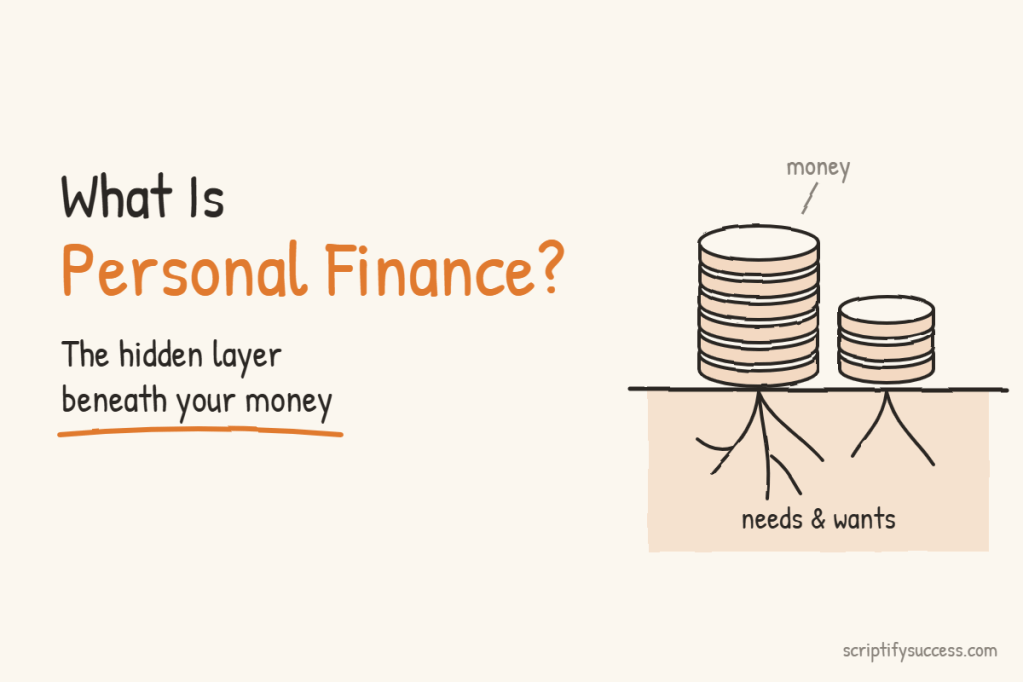
What is personal finance? Most people would say it is about money: how you earn it, spend it, save it and invest it. That answer is correct, but it only describes the top layer. Underneath it sits another layer that shapes every money decision you make, and that layer is your needs and wants.
In this article, you will first see what personal finance covers and why the figures behind each part matter. Then we will go one layer deeper and look at how your needs and wants drive those figures.
What Is Personal Finance? The Simple Meaning
Personal finance is the complete life cycle of the money you earn, spend, save and invest. Money comes into your life, part of it goes out, part of it is set aside, and part of it is put to work so it can grow. Then the cycle starts again, month after month and year after year.
Knowing these four parts by name is not enough, though. For each part, you need to know two things: where the money comes from or goes, and how much. The figures are what turn a general idea into a clear picture of your own situation.
Earning: Where Your Money Comes From
Earning is how money comes into your life. For most people it comes from a job, but it can also come from a business or a side hustle. Some people have one source of income, while others have two or three.
This is where the figures start. How much do you earn from each source every month, and how much over a year? Which source is steady, and which one goes up and down? Once you know where your money comes from and how much each source brings in, you know what you are working with.
Spending: Where Your Money Goes Today
Spending is how money leaves your life. Some of it pays for things you must have, like rent, food and clothes. Some of it pays for luxury items, or a party with friends just for fun.
Here too, look at the figures. How much goes to rent each month? How much to food, to clothes, and to fun? Knowing the amount for each area shows you where your money really goes, not where you think it goes.
Saving: Money for Future Spending
Saving is money you set aside and keep, in a savings account or a fixed-term deposit. But saved money is not meant to sit there forever. Sooner or later, it gets spent too. The only difference is that it is spent in the future instead of today.
So think of saving as future spending. Know how much you save each month, where you keep it, and what future spending it is meant for.
Investing: Money That Grows for Later
Investing is money you put to work so it can grow, for example in the stock market or in real estate (property, as many UK readers call it). Like saving, investing is also future spending. You invest today so that more money is there when a future need arrives.
Again, the figures matter. Know how much you have invested, where it is invested, and what it is meant for later.
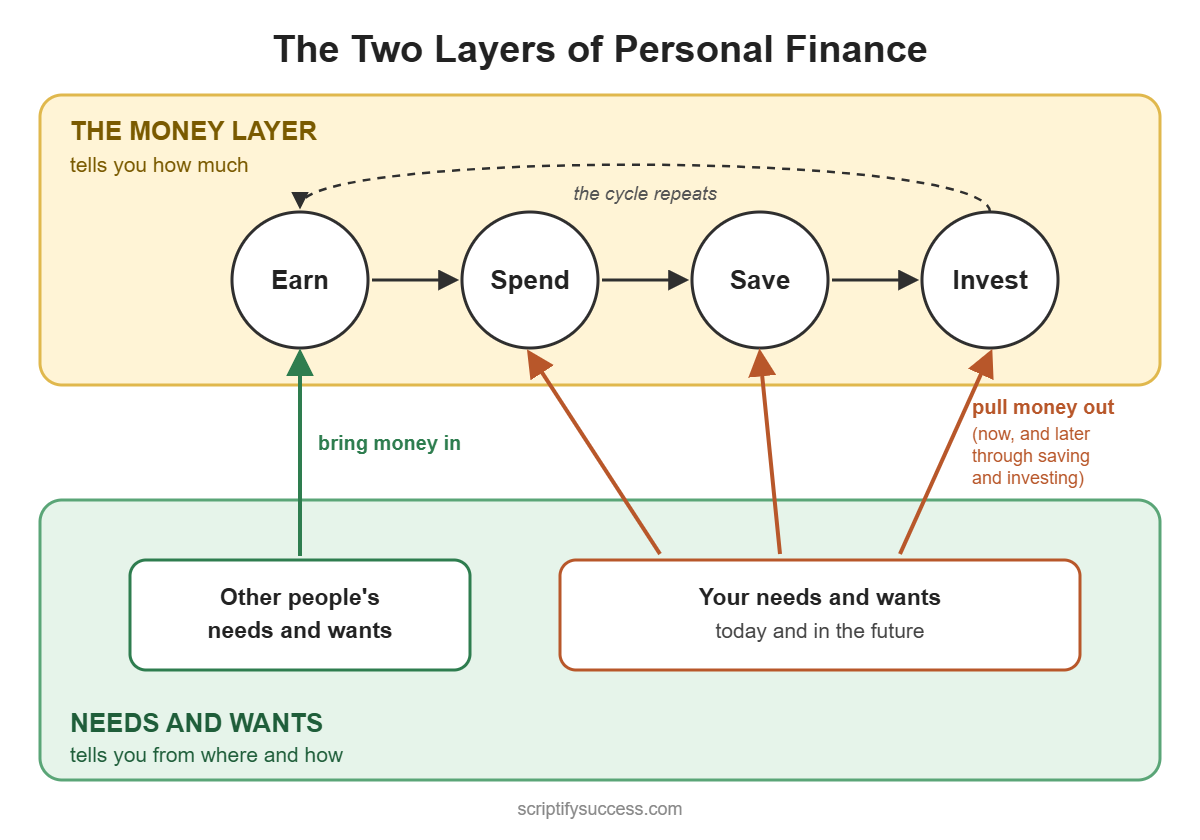
Together, earning, spending, saving and investing make up the money layer of personal finance. This layer tells you how much.
The Deeper Layer: Needs and Wants
You may already know these four parts well. But the money layer does not explain why money moves the way it does. Why do you spend on some things and not on others? Why does anyone pay you for your work in the first place? To answer these questions, you have to go one layer deeper, to your needs and wants.
A need is something you must have, and a want is something you would like to have. Look back at the spending list: rent, food and clothes are needs, while luxury items and parties for fun are wants. The line is not always sharp, though. Clothes are a need, but designer clothes for everyday use are usually a want. Being honest about which side each purchase sits on is part of understanding your finances.
Some wants can also feel like needs. A new phone when your current one works fine can feel urgent in the moment, but it is still a want. Noticing this helps you see where your money really goes.
Money is simply what you use to pay for the value of the things you need and want. When you pay rent, you are paying for a place to live. When you buy groceries, you are paying for the food your body needs. The money stands for that value.
Money Moves in Two Directions
This works in both directions. Your own needs and wants are the reason you spend. There are things you must have and things you would like to have, and you pay money to get them.
Other people’s needs and wants are the reason you earn. When your work fulfills someone else’s need or want, they pay you money in exchange for the value of that work. Here are a few everyday examples:
- A nurse gets paid because patients need care.
- A baker gets paid because people need bread.
- A teacher gets paid because children need to learn.
- A musician gets paid because people want a fun night out.
In each case, the money follows a need or a want.
So to understand personal finance and manage it well, you need to understand both sides: the needs and wants you have, which shape where your money goes, and the needs and wants others have from you, which shape where your money comes from.
Saving and Investing: Needs and Wants for Later
Saving and investing belong to this layer too, just not to today’s needs and wants. When you save or invest, you set money aside for needs and wants that will come later, so that the money is there when the time comes.
So look at the saving and investing you do today, and ask yourself one question: what need do I want to fulfill later with this money?
Two Layers That Work Hand in Hand
Picture the two layers together. On top is the money layer of earning, spending, saving and investing, and it tells you how much. Underneath is the layer of needs and wants, and it tells you from where and how. Like money, this layer has its own life cycle.
Neither layer works well alone. To understand your personal finance, you need to know both and make decisions at both.
What Changed for Me
For a long time, I tried to manage my personal finances, but I never got the results I was looking for. Every plan felt like a struggle, and keeping it going was even harder.
Then I took time to think deeply. I went back to the records I had kept of my money, looked for patterns in them, and learned from what I saw. That is when I realized I was only working on the money layer, while underneath I was struggling to align my needs and wants.
Once I started making decisions at that deeper layer, the results at the money layer changed on their own. Since then, I work on both layers together. The money layer tells me how much, and the layer underneath tells me from where and how.
Think of It Like Your Health
Say you want to be healthy, strong and full of stamina. So you start working out, which is a great first step. But exercise is only one part of the picture, because your body has another input: food. No matter how hard you train, exercise alone can never make you healthy or keep you healthy without a good, balanced diet that fits what your body needs.
Personal finance works the same way. Working only on the money layer is like working out and ignoring food. You can track every figure you earn and spend, but if you don’t understand the needs and wants underneath, you are missing a big part of the picture.
Try This
- Write down what you spent money on last month, with the amount for each item. Mark each one as a need or a want.
- Add up both sides. Are you spending more on needs or on wants? Knowing this helps you make better decisions about money.
- List each source of your income and how much it brings in. Next to each, write the needs or wants of other people that it fulfills.
- List what you save and invest, and how much. Next to each, write the future need it is for.
Key Takeaway
Personal finance has two layers. The money layer tells you how much, and the needs-and-wants layer underneath tells you from where and how. Work on both, and your money decisions become much clearer.
Frequently Asked Questions
What is personal finance in simple words?
Personal finance is the complete life cycle of the money you earn, spend, save and invest.
What are the main parts of personal finance?
The main parts are earning, spending, saving and investing. For each one, you need to know where the money comes from or goes, and how much.
What are needs and wants in personal finance?
A need is something you must have, like rent, food and clothes. A want is something you would like to have, like luxury items or a party for fun. Your needs and wants shape where your money goes, and other people’s needs and wants shape where it comes from.
How are saving and investing linked to needs and wants?
Saving and investing are future spending. You set money aside today for needs and wants that will come later, so that the money is there when the time comes.


Leave a Reply